How Did the Greeks Become to Advance Again

Ancient Greek technology adult during the 5th century BC, standing up to and including the Roman period, and beyond. Inventions that are credited to the aboriginal Greeks include the gear, spiral, rotary mills, bronze casting techniques, water clock, water organ, the torsion catapult, the use of steam to operate some experimental machines and toys, and a nautical chart to find prime numbers. Many of these inventions occurred late in the Greek menses, often inspired by the demand to improve weapons and tactics in war. However, peaceful uses are shown by their early on development of the watermill, a device which pointed to farther exploitation on a large calibration under the Romans. They developed surveying and mathematics to an advanced state, and many of their technical advances were published by philosophers, like Archimedes and Heron.
Water engineering science [edit]
Some fields that were encompassed in the surface area of h2o resources (mainly for urban use) included groundwater exploitation, construction of aqueducts for water supply, tempest water and wastewater sewerage systems, flood protection. and drainage, construction and use of fountains, baths and other sanitary and purgatory facilities, and fifty-fifty recreational uses of h2o.[v] First-class examples of these technologies include the drainage organisation establish in the Anatolian due west coast, which featured an unusual masonry outlet structure that allowed cocky-cleaning of the drainage outlet.[vi] The applied science, which demonstrated the Greek understanding of the importance of aseptic conditions to public health, was function of an elaborate drainage organization and underground water supply network.[half dozen]
Mining [edit]
The Greeks developed all-encompassing silver mines at Laurium, the profits from which helped support the growth of Athens equally a city-country. Information technology involved mining the ores in underground galleries, washing them, and smelting it to produce the metal. Elaborate washing tables still exist at the site, which used rainwater held in cisterns and collected during the winter months. Mining also helped to create currency past the conversion of the metal into coinage. Greek mines had tunnels that were as deep as 330 feet and were worked by slaves using picks and iron hammers.[7] The extracted ore were lifted by pocket-size skips hauled by a rope that was sometimes guided by a wheel placed against the rim of the mine shaft.[8]
Inventions [edit]
| Engineering science | Date | Clarification | |
|---|---|---|---|
| Archimedes' spiral | c. tertiary century BC | This device, capable of lifting solid or liquid substances from a lower plane to a college top, is traditionally attributed to the Greek mathematician Archimedes of Syracuse.[9] [10] |  |
| Streets | c. 400 BC | Case: The Porta Rosa (quaternary–3rd century BC) was the principal street of Elea (Italy) and continued the northern quarter to the southern quarter. The street is 5 meters broad. At its steepest, information technology inclines to 18%. Information technology is paved with limestone blocks, girders cut in square blocks, and on i side a small gutter for the drainage of rainwater. The edifice is dated during the fourth dimension of the reorganization of the city during the Hellenistic age. (4th to 3rd centuries BC) | 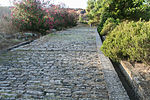 |
| Cartography | c. 600 BC | First widespread amalgamation of geographical maps developed past Anaximander, although it is possible he had been exposed to mapmaking practices of the Nigh East.[xi] | |
| Rutway | c. 600 BC | The 6 to 8.5 km long Diolkos represented a rudimentary course of railway.[12] |  |
| Differential gears | c. 100–lxx BC | The Antikythera mechanism, from the Roman-era Antikythera wreck, employed a differential gear to decide the angle between the ecliptic positions of the sun and moon, and thus the phase of the moon.[xiii] [14] | 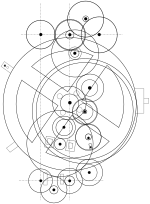 |
| Caliper | sixth century BC | Earliest instance found in the Giglio wreck nigh the Italian coast. The wooden piece already featured ane fixed and a movable jaw.[15] [16] | |
| Truss roof | 550 BC[17] | See List of Greco-Roman roofs | |
| Crane | c. 515 BC | Labor-saving device that immune the employment of small and efficient piece of work teams on construction sites. Subsequently winches were added for heavy weights.[18] |  |
| Escapement | 3rd century BC | Described past the Greek engineer Philo of Byzantium (third century BC) in his technical treatise Pneumatics (affiliate 31) equally part of a washstand automaton for guests washing their hands. Philon'south comment that "its structure is similar to that of clocks" indicates that such escapement mechanisms were already integrated in ancient water clocks.[19] | |
| Tumbler lock | c. fifth century BC | The tumbler lock, likewise as other varieties of lock, was introduced in Greece in the fifth century BC. | |
| Gears | c. 5th century BC | Developed further than in prehistoric times for a multifariousness of practical purposes. | |
| Plumbing | c. fifth century BC | Although there is testify for Sanitation of the Indus Valley Civilisation, the aboriginal Greek civilisation of Crete, known as the Minoan culture, was the first civilization to use underground clay pipes for sanitation and water supply.[20] Excavations at Olympus, too as Athens, have revealed all-encompassing plumbing systems for baths, fountains, and personal use. | |
| Spiral staircase | 480–470 BC | The primeval spiral staircases appear in Temple A in Selinunte, Sicily, to both sides of the cella. The temple was constructed around 480–470 BC.[21] |  |
| Urban planning | c. 5th century BC | Miletus is one of the first known towns in the world to take a grid-like plan for residential and public areas. It accomplished this feat through a variety of related innovations in areas such equally surveying. | |
| Winch | 5th century BC | The earliest literary reference to a winch tin be found in the account of Herodotus of Halicarnassus on the Persian Wars (Histories seven.36), where he describes how wooden winches were used to tighten the cables for a pontoon bridge across the Hellespont in 480 BC. Winches may have been employed even earlier in Assyria, though. By the 4th century BC, winch and pulley hoists were regarded by Aristotle as common for architectural utilise (Mech. 18; 853b10-thirteen).[22] | |
| Showers | 4th century BC | A shower room for female athletes with plumbed-in water is depicted on an Athenian vase. A whole complex of shower-baths was also found in a second-century BC gymnasium at Pergamum.[23] | |
| Key heating | c. 350 BC | Peachy Temple of Ephesus was warmed past heated air that was circulated through flues laid on the flooring. | |
| Lead capsule | c. 350 BC | To protect a ship's hull from wearisome creatures; run into Kyrenia ship | |
| Canal lock | early third century BC | Built into Ancient Suez Canal under Ptolemy II (283–246 BC).[24] [25] [26] | |
| Ancient Suez Canal | early 3rd century BC | Opened by Greek engineers nether Ptolemy II (283–246 BC), following earlier, probably just partly successful attempts.[27] | |
| Lighthouse | c. 3rd century BC | Co-ordinate to Homeric fable, Palamidis of Nafplio invented the first lighthouse, although they are certainly attested with the Lighthouse of Alexandria (designed and constructed past Sostratus of Cnidus) and the Colossus of Rhodes. Notwithstanding, Themistocles had earlier established a lighthouse at the harbor of Piraeus connected to Athens in the fifth century BC, essentially a small rock cavalcade with a fire buoy.[28] | |
| H2o wheel | 3rd century BC | Kickoff described by Philo of Byzantium (c. 280–220 BC).[29] | |
| Alarm clock | third century BC | The Hellenistic engineer and inventor Ctesibius (fl. 285–222 BC) fitted his clepsydras with a dial and pointer for indicating the time, and added elaborate "alarm systems, which could be made to drop pebbles on a gong, or accident trumpets (by forcing bong-jars down into h2o and taking the compressed air through a beating reed) at pre-set times" (Vitruv 11.11).[xxx] | |
| Odometer | c. 3rd century BC | Odometer, a device used in the tardily Hellenistic time and by Romans for indicating the distance traveled by a vehicle. Information technology was invented sometime in the 3rd century BC. Some historians attribute information technology to Archimedes, others to Heron of Alexandria. It helped revolutionize the building of roads and traveling by them by accurately measuring distance and being able to advisedly illustrate this with a milestone. | |
| Chain drive | tertiary century BC | First described past Philo of Byzantium, the device powered a repeating crossbow, the beginning known of its kind.[31] | |
| Cannon | c. 3rd century BC | Ctesibius of Alexandria invented a archaic form of the cannon, operated past compressed air. | |
| Double-action principle | third century BC | Universal mechanical principle that was discovered and first applied past the engineer Ctesibius in his double-action piston pump, which was later adult further by Heron to a fire hose (come across beneath).[32] | |
| Levers | c. 260 BC | Beginning described about 260 BC past the ancient Greek mathematician Archimedes. Although used in prehistoric times, they were first put to practical apply for more developed technologies in Aboriginal Greece.[33] | |
| Water mill | c. 250 BC | The use of water power was pioneered by the Greeks: The earliest mention of a water mill in history occurs in Philo's Pneumatics, previously been regarded as a after Standard arabic interpolation, merely according to recent research to be of authentic Greek origin.[1] [34] | |
| Three-masted transport (mizzen) | c. 240 BC: | Outset recorded for Syracusia besides as other Syracusan (merchant) ships nether Hiero II of Syracuse[35] | |
| Gimbal | third century BC | The inventor Philo of Byzantium (280–220 BC) described an eight-sided ink pot with an opening on each side, which can be turned so that whatever face up is on acme, dip in a pen and ink it-yet the ink never runs out through the holes of the side. This was done by the pause of the inkwell at the center, which was mounted on a series of concentric metal rings which remained stationary no thing which way the pot turns itself.[36] |  |
| Dry dock | c. 200 BC | Invented in Ptolemaic Egypt nether Ptolemy Iv Philopator (reigned 221–204 BC) every bit recorded by Athenaeus of Naucratis(V 204c-d).[37] [38] | |
| Fore-and-aft rig (spritsail) | 2nd century BC | Spritsails, the primeval fore-and-aft rigs, appeared in the 2d century BC in the Aegean Sea on minor Greek arts and crafts.[39] |  |
| Air and water pumps | c. 2nd century BC | Ctesibius and various other Greeks of Alexandria of the period developed and put to practical use various air and water pumps which served a multifariousness of purposes,[twoscore] such every bit a water organ and, by the 1st century Advertisement, Heron's fountain. | |
| Sakia gear | 2d century BC | Get-go appeared in 2d-BC Hellenistic Egypt, where pictorial evidence already showed it fully adult[41] | |
| Surveying tools | c. second century BC | Diverse records relating to mentions of surveying tools accept been discovered, mostly in Alexandrian sources, these greatly helped the development of the precision of Roman aqueducts. | |
| Analog computers | c. 150 BC | In 1900–1901, the Antikythera mechanism was found in the Antikythera wreck. It is thought that this device was an analog estimator designed to calculate astronomical positions and was used to predict lunar and solar eclipses based on Babylonian arithmetic-progression cycles. Whereas the Antikythera machinery is considered the proper analog estimator, the astrolabe (besides invented by the Greeks) may be considered as a forerunner.[42] |  |
| Burn hose | 1st century BC | Invented by Heron based on Ctesibius' double-action piston pump.[32] Allowed for more efficient fire fighting. | |
| Vending machine | 1st century BC | The first vending machine was described by Heron of Alexandria. His machine accepted a money then dispensed a fixed amount of holy water. When the coin was deposited, it roughshod upon a pan fastened to a lever. The lever opened up a valve, which let some h2o flow out. The pan continued to tilt with the weight of the coin until it barbarous off, at which signal a counter-weight would snap the lever back up and turn off the valve.[32] | |
| Wind vane | 50 BC | The Tower of the Winds on the Roman agora in Athens featured atop a wind vane in the form of a bronze Triton holding a rod in his outstretched hand rotating to the current of air blowing. Beneath, its frieze was adorned with the eight current of air deities. The eight grand loftier construction likewise featured sundials and a water clock inside dates from around 50 BC.[43] | |
| Clock belfry | 50 BC | See Clock tower.[44] | 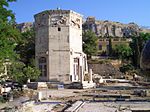 |
| Automatic doors | c. 1st century Advertizement | Heron of Alexandria, a 1st-century BC inventor from Alexandria, Arab republic of egypt, created schematics for automatic doors to be used in a temple with the aid of steam power.[32] [ expressionless link ] |
See besides [edit]
- Museum of Aboriginal Greek Engineering science
- Roman applied science
- Medieval technology
- Listing of Byzantine inventions
References [edit]
- ^ a b c Wilson, Andrew (2002). "Machines, Power and the Aboriginal Economy". The Journal of Roman Studies. 92: one–32 (7f.). doi:10.1017/s0075435800032135. JSTOR 3184857.
- ^ Wikander, Örjan (1985). "Archaeological Testify for Early Water-Mills. An Interim Report". History of Engineering. ten: 151–179 (160).
- ^ Wikander, Örjan (2000). "The Water-Factory". Handbook of Aboriginal Water Technology. Technology and Change in History. Vol. 2. Leiden: Brill. pp. 371–400 (396f.). ISBN90-04-11123-9.
- ^ Donners, K.; Waelkens, M.; Deckers, J. (2002). "Water Mills in the Area of Sagalassos: A Disappearing Ancient Engineering". Anatolian Studies. 52: 1–17 (11). doi:10.2307/3643076. JSTOR 3643076.
- ^ Angelfish, A. Due north.; Outsourcing, D. (2003). "Urban water applied science and management in aboriginal Greece". In Stewart, B.A.; Howell, T. (eds.). The Encyclopedia of Water Science. New York: Decker. pp. 999–1007. ISBN0-8247-0948-ix.
- ^ a b Mays, Larry (2010). Ancient Water Technologies. Dordrecht: Springer. p. 16. ISBN9789048186310.
- ^ Samuels, Charlie (2013). Technology in Ancient Greece. New York: Gareth Stevens Publishing LLLP. p. 36. ISBN9781433996337.
- ^ Forbes, Robert (1966). Studies in Ancient Applied science, Volume iv. Leiden: Brill Archive. p. 145.
- ^ Oleson, John Peter (2000), "H2o-Lifting", in Wikander, Örjan (ed.), Handbook of Ancient Water Engineering science, Technology and Change in History, vol. two, Leiden, pp. 217–302 (242–251), ISBNxc-04-11123-9
- ^ David Sacks (2005) [1995]. Oswin Murray and Lisa R. Brody (eds), Encyclopedia of the Ancient Greek World. Revised Edition. New York: Facts on File. ISBN 0-8160-5722-2, pp 303-304.
- ^ Alex C. Purves (2010). Space and Time in Ancient Greek Narrative. Cambridge & New York: Cambridge University Press. ISBN 978-0-521-19098-5, pp 98-99.
- ^ Lewis, One thousand. J. T. (2001) "Railways in the Greek and Roman world" Archived February 16, 2008, at the Wayback Machine, in Guy, A. / Rees, J. (eds), Early Railways. A Selection of Papers from the First International Early Railways Conference, pp. 8–19 (eight & fifteen), ISBN 090468508X.
- ^ Wright, M. T. (2007). "The Antikythera Mechanism reconsidered" (PDF). Interdisciplinary science reviews. 32 (one). Retrieved 20 May 2014.
- ^ Bernd Ulmann (2013). Analog Computing. Munich: Oldenbourg Verlag München. ISBN 978-3-486-72897-2, p. 6.
- ^ Spring, Mensun (1991) The Giglio wreck: a wreck of the Archaic period (c. 600 BC) off the Tuscan island of Giglio, Hellenic Institute of Marine Archæology, Athens.
- ^ Ulrich, Roger B. (2007) Roman woodworking, Yale University Printing, New Haven, Conn., pp. 52f., ISBN 0-300-10341-7.
- ^ Hodge, A. Trevor Paul (1960) The Woodwork of Greek Roofs, Cambridge University Press, p. 41.
- ^ Coulton, J. J. (1974), "Lifting in Early Greek Architecture", The Journal of Hellenic Studies, 94: 1–nineteen (7), doi:10.2307/630416, JSTOR 630416
- ^ Lewis, Michael (2000). "Theoretical Hydraulics, Automata, and H2o Clocks". In Wikander, Örjan (ed.). Handbook of Ancient Water Engineering science. Applied science and Change in History. Vol. 2. Leiden. pp. 343–369 (356f.). ISBN90-04-11123-9.
- ^ "The History of Plumbing - CRETE". theplumber.com. theplumber.com. Retrieved 26 March 2014.
- ^ Ruggeri, Stefania : „Selinunt", Edizioni Affinità Elettive, Messina 2006 ISBN 88-8405-079-0, p.77
- ^ Coulton, J. J. (1974). "Lifting in Early Greek Architecture". The Journal of Hellenic Studies. 94: 1–19 (12). doi:10.2307/630416. JSTOR 630416.
- ^ Aboriginal Inventions: Showers. inventions.org
- ^ Moore, Frank Gardner (1950). "3 Canal Projects, Roman and Byzantine". American Journal of Archaeology. 54 (2): 97–111 (99–101). doi:10.2307/500198.
- ^ Froriep, Siegfried (1986): "Ein Wasserweg in Bithynien. Bemühungen der Römer, Byzantiner und Osmanen", Antike Welt, 2d Special Edition, pp. 39–50 (46)
- ^ Schörner, Hadwiga (2000): "Künstliche Schiffahrtskanäle in der Antike. Der sogenannte antike Suez-Kanal", Skyllis, Vol. iii, No. ane, pp. 28–43 (33–35, 39)
- ^ Schörner, Hadwiga (2000): "Künstliche Schiffahrtskanäle in der Antike. Der sogenannte antike Suez-Kanal", Skyllis, Vol. 3, No. 1, pp. 28–43 (29–36)
- ^ Elinor Dewire and Dolores Reyes-Pergioudakis (2010). The Lighthouses of Greece. Sarasota: Pineapple Press. ISBN 978-1-56164-452-0, pp ane-v.
- ^ Oleson, John Peter (2000): "Water-Lifting", in: Wikander, Örjan: "Handbook of Ancient Water Engineering science", Applied science and Change in History, Vol. 2, Brill, Leiden, ISBN xc-04-11123-ix, pp. 217–302 (233)
- ^ Landels, John G. (1979). "H2o-Clocks and Time Measurement in Classical Antiquity". Endeavour. iii (1): 32–37 [35]. doi:10.1016/0160-9327(79)90007-iii.
- ^ Werner Soedel, Vernard Foley: Ancient Catapults, Scientific American, Vol. 240, No. 3 (March 1979), p.124-125
- ^ a b c d Jaffe, Eric (December 2006) Old World, Loftier Tech: Earth's First Vending Motorcar. Smithsonian mag.
- ^ Usher, A. P. (1929). A History of Mechanical Inventions. Harvard University Press (reprinted by Dover Publications 1988). p. 94. ISBN978-0-486-14359-0. OCLC 514178. Retrieved 7 April 2013.
- ^ Lewis, M. J. T. (1997) Millstone and Hammer: the origins of water power, Academy of Hull Press, pp. 1–73 especially 44–45 and 58–lx, ISBN 085958657X.
- ^ Casson, Lionel (1995): "Ships and Seamanship in the Ancient Earth", Johns Hopkins University Press, pp. 242, fn. 75, ISBN 978-0-8018-5130-8.
- ^ Sarton, Chiliad. (1970) A History of Science, The Norton Library, Vol. 2., pp. 343–350, ISBN 0393005267.
- ^ "Athenaeus: Deipnosophists - Book 5 (b)". www.attalus.org.
- ^ Oleson 1984, p. 33
- ^ Casson, Lionel (1995): "Ships and Seamanship in the Ancient World", Johns Hopkins University Printing, pp. 243–245, ISBN 978-0-8018-5130-viii.
- ^ David Sacks (2005) [1995]. Oswin Murray and Lisa R. Brody (eds), Encyclopedia of the Ancient Greek Globe. Revised Edition. New York: Facts on File. ISBN 0-8160-5722-2, p. 303.
- ^ Oleson, John Peter (2000): "H2o-Lifting", in: Wikander, Örjan: "Handbook of Ancient H2o Applied science", Technology and Change in History, Vol. 2, Brill, Leiden, pp. 217–302 (234, 270), ISBN 90-04-11123-ix.
- ^ Bernd Ulmann (2013). Analog Computing. Munich: Oldenbourg Verlag München. ISBN 978-3-486-72897-2, pp 5-6
- ^ Noble, Joseph Five. and de Solla Toll, Derek J. (1968). "The H2o Clock in the Tower of the Winds" (PDF). American Journal of Archaeology. 72 (four): 345–355 (353). doi:10.2307/503828. JSTOR 503828.
{{cite periodical}}: CS1 maint: uses authors parameter (link) - ^ Noble, Joseph V. and de Solla Price, Derek J. (1968). "The Water Clock in the Tower of the Winds" (PDF). American Journal of Archaeology. 72 (4): 345–355 (349). JSTOR 503828.
{{cite journal}}: CS1 maint: uses authors parameter (link)
Sources [edit]
- Oleson, John Peter (1984), Greek and Roman Mechanical H2o-Lifting Devices: The History of a Technology, University of Toronto Printing, ISBN90-277-1693-5
Further reading [edit]
- Kotsanas, Kostas (2009) - "Familiar and Unfamiliar Aspects of Aboriginal Greek Technology" (ISBN 978-9963-9270-2-9)
- Kotsanas, Kostas (2008) - "Ancient Greek Technology" (ISBN 978-960-930859-5)
External links [edit]
- What the Aboriginal Greeks did for us, BBC documentary
Source: https://en.wikipedia.org/wiki/Ancient_Greek_technology

Post a Comment for "How Did the Greeks Become to Advance Again"