How nature-based solutions can fight climate change, mitigate sea-level rise
SINGAPORE: Planting mangrove forests to complement sea walls could slow the tide when it comes to rising sea levels - this is i example of a nature-based solution that Singapore can adopt to deal with the effects of climate modify.
And compared to stone and concrete, mangroves would provide more than than coastal protection by conserving biodiversity and helping to reduce carbon emissions. Mangrove forests, which in one case lined much of Singapore's coastline, are able to store carbon more efficiently than other ecosystems such every bit tropical rainforests.
"I think in Singapore, the focus has traditionally been on human-engineered solutions - sea walls and breakers and then on. I recall there is also scope to utilise mangroves or sea grasses and other natural coastal habitats to help with reducing the erosion effects," said Professor Koh Lian Pin, who heads the new Centre for Nature-based Climate Solutions at the National University of Singapore (NUS).
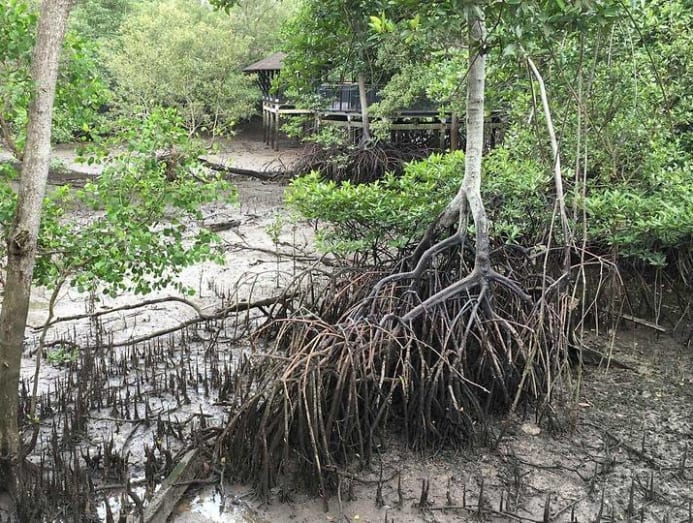
Nature-based solutions include protecting natural ecosystems, restoring them and improving the management of agricultural lands to reduce greenhouse gas emissions that outcome from deforestation.
"We desire to remove emissions from the atmosphere, by making use of the wood'southward natural ability to convert carbon dioxide into organic carbon that will be stored in the biomass above ground as well every bit in the soil below ground," said Prof Koh.
However, he added that these solutions may not be suitable everywhere equally that depends on many factors. In the case of planting mangroves, factors include where the coastline is, the waves, weather events and more.
READ: How Singapore's mangroves tin can contribute in the battle against climate change
Such complications are role of what he and his colleagues study in guild to inform the strategies, policies and actions on climatic change in Singapore and the region.
A prominent researcher in the field of sustainability and environmental science, Prof Koh has worked in institutions across Switzerland, Australia and the Us over the concluding 16 years.
He is the sixth Singaporean scientist who returned under the National Research Foundation's Returning Singaporean Scientists Scheme to lead research in areas important to the country.
The Middle for Nature-based Climate Solutions was announced by NUS in March and is due to officially open past the stop of the year, just it has already been agile, publishing ane research study in August and some other one soon.
The showtime newspaper, on the potential and constraints of reforestation, found that 121 million ha of country across Southeast Asia are suitable for reforestation, and could potentially contribute to climate mitigation at a rate of 3.four gigatonnes of carbon dioxide a year.
In contrast, Singapore generated 52.v 1000000 tonnes of greenhouse gases in 2017. One gigatonne is equivalent to 1 billion tonnes.
READ: 52.5m tonnes of greenhouse gases generated by Singapore in 2017: MTI
READ: New technologies, continuous innovation primal as globe moves towards low-carbon future, say experts
Merely when "layers of constraints" are taken into consideration, such every bit how much of the land may exist used by local farmers, as well as the manpower and resources required to manage these reforestation projects, the area of country available for reforestation can chop-chop compress.
The report estimated it could exist as picayune equally 33 million ha instead, which would provide but 0.ix gigatonnes of carbon dioxide sequestration potential a year.

While barriers to reforestation can exist overcome, studying both the potential and limits of such nature-based climate solutions is needed for climate policies that are workable.
For example, if a company or the government were interested in a reforestation project somewhere in Borneo, and if the land is being used past local communities for growing food crops, then at that place will be the adventure of impact on the land users' rights, security and livelihoods, he explained.
"Agreement both these kinds of opportunities and risks can help determination-makers policymakers prioritise what, when, and how these solutions should be implemented, to aid them maximise the benefits of distributions and minimise the conflicts and negative impacts," Prof Koh said.
READ: Caught by deluges and droughts, Republic of india's cities look to get climate smarter
The 2nd inquiry written report, which the centre has just completed, is a carbon prospecting map showing where the highest, investable carbon is stored around the earth in the biomass and soil of forests.
Interest in such information is growing as global need for nature-based carbon credits is outpacing their supply. Carbon credits are traded by governments, companies and other entities to commencement their emissions, and nature-based credits tin exist generated by funding wood conservation and restoration projects.
This twelvemonth, the Trillion Tree Campaign was appear at the 2022 World Economical Forum in Davos - aiming to plant one trillion copse worldwide past the end of the decade. Singapore is doing its part past pledging to plant a one thousand thousand copse by 2030.
READ: Look across forests for toll-effective nature restoration, governments urged
It has been estimated that nature-based solutions tin can provide up to a tertiary of the mitigation needed to hold global average temperature rising to beneath the 2 degree Celsius target in the Paris Climate Understanding.
"Fifty-fifty if we managed to decarbonise through energy transitions or improving our energy efficiency, we nevertheless may not see the targets, unless we also human action on the nature-based part of the solution," Prof Koh said.
Singapore can too invest in better understanding the less obvious and insidious touch on of climatic change, he said. This includes its effect on the security of its regional food supply, its water resources, every bit well equally the bear upon on the regional economy and political stability.
"Because whatever happens to our neighbours because of climate change, the impacts will eventually trickle down to Singapore," he said.
Commentary: Reaching net-zero emissions will be 'very challenging'. But watch Singapore endeavor anyway
The centre'southward role is to provide the science that can aid show where the trade-offs are when implementing climate solutions.
"That's why science is important to inform decisions on where we should be prioritising the implementation of our solutions to maximise the benefits … after careful consideration of, not just the ecology issues, simply also the socio-economic, cultural and geopolitical contexts of the region. That'southward the kind of interdisciplinary science that the center is focussing on," he said.
Source: https://cnalifestyle.channelnewsasia.com/sustainability/how-nature-based-solutions-can-fight-climate-change-mitigate-sea-level-rise-297586

Post a Comment for "How nature-based solutions can fight climate change, mitigate sea-level rise"